
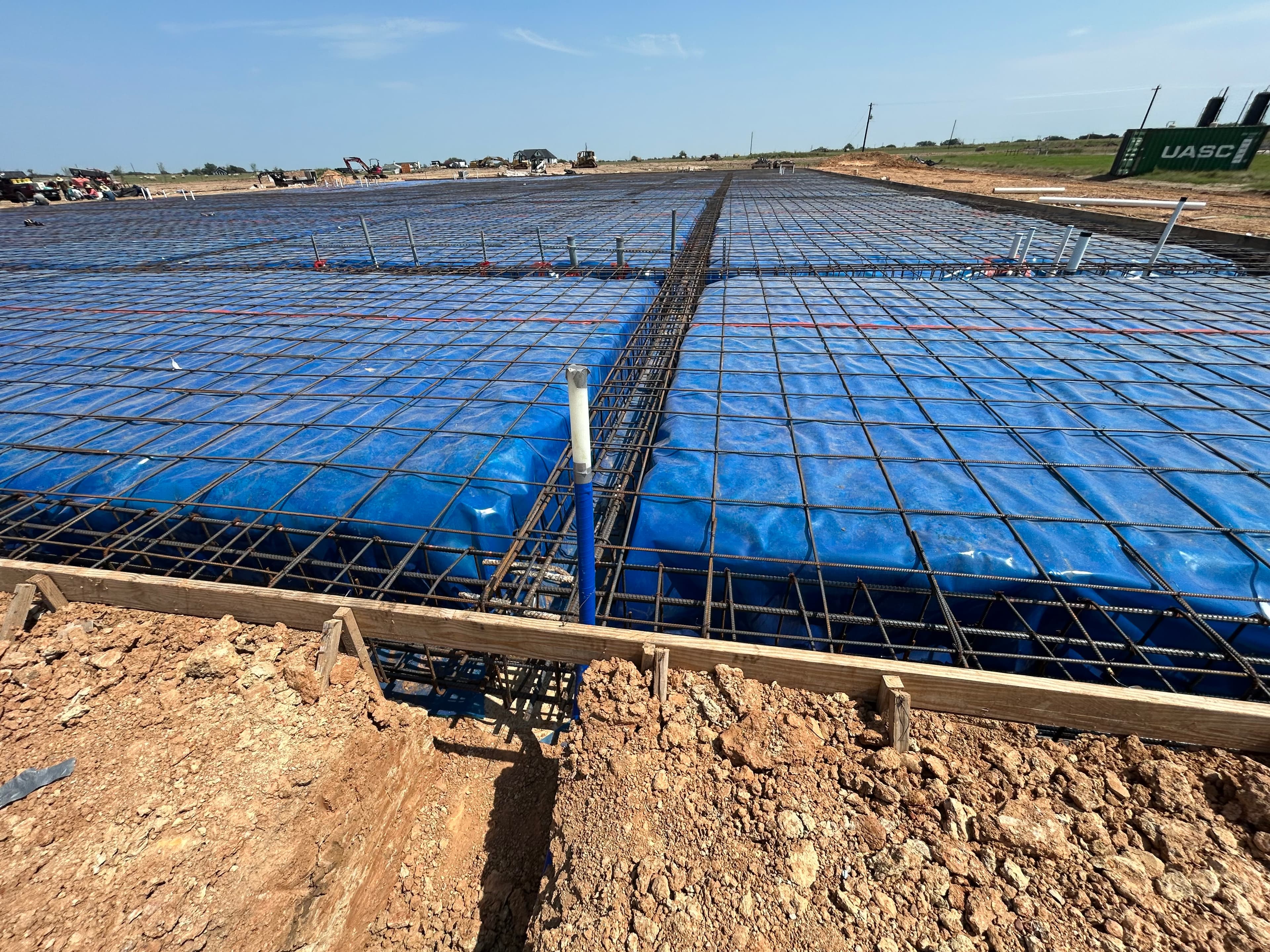
Comprehensive Building Foundations in Texas
Professional foundation construction for commercial and residential buildings
Commercial building foundations we design and build span the full spectrum: monolithic and post-tensioned slabs for light industrial and retail, drilled-pier and grade-beam systems for multi-story office and institutional buildings, and deep caisson foundations where unsuitable fill or high-plasticity clay soils require bearing loads to be transferred well below the active zone. For every project, we begin with a geotechnical report and coordinate directly with the project's structural engineer of record to confirm bearing pressures, pier spacing, and rebar schedules before a shovel hits the ground.
Our concrete mix designs reflect Texas jobsite realities: Type I/II cement with fly ash for workability in summer heat, accelerants when winter cold threatens early-strength development, and air-entrainment adjustments for freeze-thaw cycles in the Panhandle and North Texas. We pour to ACI 318 standards, use calibrated testing equipment for slump, air content, and cylinder breaks, and maintain documentation that satisfies third-party special inspection requirements on every project.
Post-Harvey FEMA flood elevation requirements add a layer of complexity on Houston-metro projects — finish floor elevations must clear the base flood elevation by the required freeboard, which affects foundation stem wall heights and crawl space design throughout Harris, Galveston, Fort Bend, and Brazoria counties. We carry that coordination through the permit set so property owners are not surprised by a re-design after the slab is already poured. Across Texas, we manage TxDOT driveway access permits, municipal public works submittals, and building department inspections from groundbreaking through certificate of occupancy.
What's Included
- •Geotechnical report review and foundation type selection
- •Structural engineer coordination and design review
- •Excavation, subgrade preparation, and compaction testing
- •Drilled pier installation for expansive clay and soft soil sites
- •Formwork, rebar, and post-tensioning tendon installation
- •Concrete placement with ACI 318-compliant mix designs
- •Third-party special inspection coordination and documentation
- •FEMA flood elevation compliance on Harris County and Gulf Coast projects
- •Building department permit submission and inspection coordination
Frequently Asked Questions
How do Texas soil conditions affect commercial foundation design?
Texas is one of the most geologically diverse states in the country, and that diversity matters enormously for foundations. Houston and Bryan-College Station sit on high-plasticity black gumbo clay that can move three to five inches vertically through a single wet-dry cycle — commercial slabs there typically require post-tensioned design or deep drilled piers tied to a grade beam that straddles the active zone. The DFW Metroplex has similar Blackland Prairie clay, particularly in the Collin and Denton county growth corridor. San Antonio and Laredo underlies with caliche — a naturally cemented calcium carbonate layer that is dense enough to support most commercial loads but can be difficult to drill through. Hill Country sites near the Edwards Aquifer recharge zone often land on fractured limestone that offers excellent bearing capacity but presents karst dissolution risks. We review the geotechnical report before committing to any foundation type and adjust design to match what the soil actually delivers.
What is the difference between a post-tensioned slab and a conventional reinforced slab for commercial buildings in Texas?
A conventional reinforced slab uses passive rebar to resist the tensile stresses concrete cannot handle on its own. A post-tensioned slab threads high-strength steel tendons through the slab and stresses them after the concrete reaches adequate strength, which actively compresses the concrete and dramatically reduces slab thickness and cracking potential. In Texas, post-tensioned slabs became the default for residential construction on expansive clay decades ago, and the same logic applies to light commercial and industrial. We specify post-tensioned design when the geotechnical report identifies Plasticity Index values above 25, when site fill conditions are uncertain, or when the structural engineer requires it for load and span requirements. For heavier industrial loads — warehouse rack foundations, distribution center super-flat floors — we work with drilled piers and a conventionally reinforced mat or grade-beam system that eliminates soil influence on the slab entirely.
Do building foundations require permits in Texas, and how does the process work?
Yes, all commercial foundation work requires permits in Texas. The process varies by municipality but generally follows a sequence: we submit engineered foundation drawings stamped by a licensed Texas PE, the building department reviews for code compliance, and inspections are scheduled at key milestones — after excavation and before concrete placement, after form and rebar are set, and at the pour itself if a third-party special inspector is required. Houston, Dallas, Austin, and San Antonio all have online permitting portals, but processing times range from a few days for straightforward permits in smaller cities to four to eight weeks in heavily loaded municipal offices. We factor permit lead time into every project schedule from day one.
How long does a commercial foundation project take in Texas?
Timeline depends heavily on foundation type and project scale. A single-story retail slab on stable ground — site prep, subgrade compaction, vapor barrier, rebar, pour, and a five-day cure before framing loads — can be completed in two to three weeks from permit issuance. A drilled-pier and grade-beam foundation for a two-story office building in DFW clay, with pier installation, pier caps, beam forming, interior grade preparation, and slab pour, typically runs four to seven weeks. Large industrial foundation packages — a 300,000-square-foot distribution center slab poured in sections — can extend to three to four months. Weather is a real variable: Texas summers push concrete placement to early morning pours and require curing compound and wet blankets to prevent surface cracking, while Gulf Coast rain events can shut a site for days. We build weather contingencies into every schedule.
What flood elevation requirements apply to commercial foundations in the Houston area?
Harris County and all the municipalities within the Houston-Galveston region operate under FEMA Flood Insurance Rate Maps plus local amendments that frequently exceed the federal minimums. After Harvey, many communities adopted freeboard requirements of one to two feet above the base flood elevation for new commercial construction. That means finished floor elevation must be established early — before the foundation is poured — and any changes to civil grading or site drainage can cascade into a foundation redesign. We coordinate with the civil engineer and the floodplain administrator to confirm the required FFE before we finalize stem wall heights or haunch elevations, and we document the as-built elevation with a FEMA Elevation Certificate at completion. Harris County Flood Control District detention requirements may also apply to sites above a certain impervious cover threshold, which affects site layout and can influence where we locate the building footprint.
Common Situations
- •A distribution center developer in the North Houston logistics corridor needs a drilled-pier and grade-beam foundation system engineered for ESFR sprinkler loads and 30,000-pound rack leg reactions on soft clay soils
- •A medical office group in the DFW Metroplex needs a post-tensioned slab foundation designed for the high-plasticity Blackland Prairie clay common to Collin and Denton counties
- •A retail center developer in San Antonio requires a slab foundation on caliche subgrade with stem walls sized to meet FEMA freeboard requirements in a Zone AE flood plain
Example Engagement
Service Type
Comprehensive Building Foundations
Scope
A developer is constructing a 120,000-square-foot light industrial building in Southeast Houston on high-plasticity clay soils. The project requires drilled piers to stable bearing strata at 25 feet, a reinforced concrete grade beam, and a 6-inch post-tensioned interior slab designed for 2,000-pound pallet jack loads and future rack storage.
Client Situation
The developer has a geotechnical report indicating PI values above 40 and a site in Harris County with an established base flood elevation requiring finished floor at 24 inches above the adjacent crown-of-road. The structural engineer has specified 18-inch diameter drilled piers at 12-foot centers.
Our Approach
We review the geotech and structural drawings, mobilize a drilling rig to install piers to refusal on the bearing stratum, set grade beam forms and rebar per the engineer's schedule, pour grade beams and cure, then sequence the interior slab pour in panels to manage shrinkage and maintain FF45 flatness tolerance across the tenant floor.
Expected Outcome
A completed foundation system with piers, grade beams, and post-tensioned slab that meets all FEMA elevation requirements, passes Harris County building inspection, and delivers a super-flat floor ready for industrial tenant buildout.
Why Choose Us
Free Estimates
Get a detailed project estimate tailored to your specific needs and site conditions.
Expert Consultation
Our experienced team provides guidance on project requirements, permits, and best practices.
Quality Assurance
We ensure all work meets or exceeds local building codes and industry standards.