
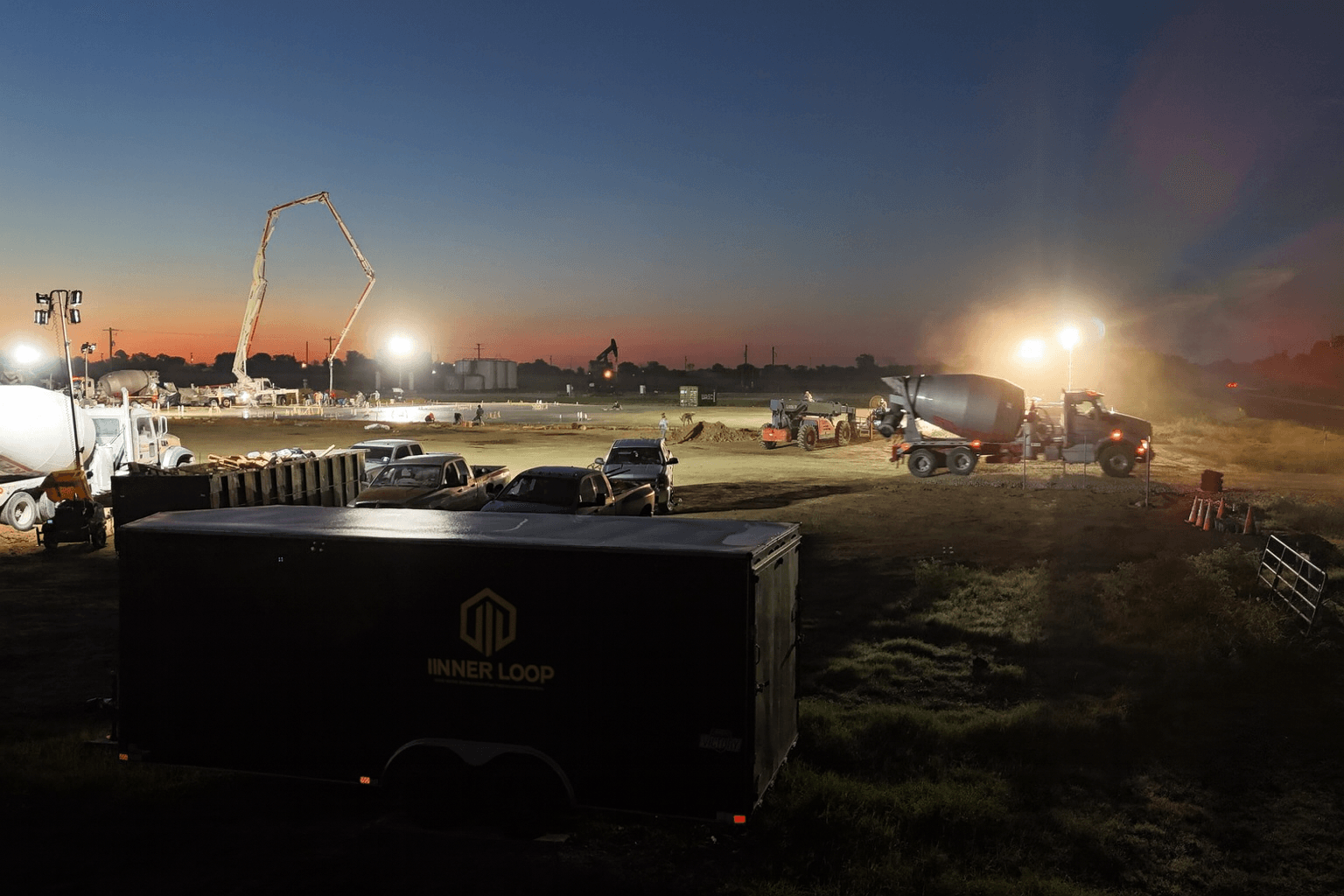
Site Preparation in Texas
Construction site preparation and grading
Texas site preparation starts with a serious engagement with the utility network. Before any ground is disturbed on a commercial site in Texas, 811 (Dig Safe Texas) notification is required by state law — but 811 locates only known utilities on record with participating utilities, and in urban infill and redevelopment sites the unmapped infrastructure left by previous owners is often more dangerous than the mapped network. We supplement 811 locates with private utility locating using ground-penetrating radar (GPR) on sites with documented prior development, and we require potholing of any utility crossing that will be within 5 feet of excavation work. That cost — typically a few thousand dollars — is trivial compared to the liability and schedule impact of a severed natural gas main or fiber optic backbone in an urban site.
Site clearing in Texas means different things in different regions. East Texas pine country clearing can involve mature timber, root systems 6 to 8 feet deep, and organic topsoil that needs to be stripped and stockpiled or hauled off before structural fill is placed. Brush clearing in South Texas and the Coastal Bend involves mesquite, huisache, and native brush with aggressive root systems that must be mechanically removed to prevent regrowth beneath pavement. In suburban DFW and Houston, clearing often means coordinating demolition of existing light commercial structures — concrete slabs, overhead utilities, and underground tanks — that require TCEQ notification for tank removal and proper disposal documentation for any petroleum-impacted soil. We manage demolition permits, asbestos survey coordination for pre-1980 structures, and disposal manifests as part of our site preparation scope.
Temporary construction access is a planning problem that many projects underestimate. In urban Houston where residential neighborhoods abut industrial redevelopment sites, truck routes, weight limits, and construction hours are often regulated by the municipality or deed restrictions. We establish a site logistics plan during pre-construction that identifies legal truck routes, haul road locations within the site, and staging areas for materials that must be sequenced properly — aggregate base before concrete, concrete before mechanical, mechanical before enclosure — so the site doesn't become a traffic management nightmare during peak construction activity.
Erosion control in Texas requires more than setting silt fence and hoping for the best. TCEQ's TPDES stormwater permit requires a Stormwater Pollution Prevention Plan (SWPPP) for sites over 1 acre, and inspectors do cite Texas contractors for inadequate BMP maintenance after rain events. We maintain our erosion controls actively — reinstalling silt fence after damage, cleaning sediment from inlet protection devices, and documenting all BMP maintenance in the SWPPP log. On sites near sensitive water bodies (common in Central Texas near the Edwards Aquifer recharge zone) we take additional precautions with concrete washout location, fuel storage containment, and chemical material storage to keep these areas out of stormwater runoff.
Construction staging area design is a professional discipline, not an afterthought. An organized site with a designated concrete washout, material lay-down zone, worker parking area, and temporary office location runs faster and cleaner than one where these elements are improvised daily. We design the staging area for a project as part of the pre-construction site logistics plan, and we maintain it through the construction period so we're not adding cost and delay from site disorganization at the peak of the construction schedule.
What's Included
- •811 utility locate coordination and private GPR utility locating
- •Demolition of existing improvements with asbestos survey coordination
- •Underground tank removal coordination and impacted soil management
- •Clearing, grubbing, and topsoil stripping
- •TPDES SWPPP preparation, BMP installation, and ongoing maintenance
- •Temporary construction access and haul road establishment
- •Material staging areas, concrete washout, and trailer placement
- •Site security fencing and access control
- •Rough grading to civil plan including initial drainage slope
- •Coordination with all utility service providers for installation sequencing
Frequently Asked Questions
What does commercial site preparation include in Texas?
Commercial site preparation in Texas typically includes 811 utility locate coordination plus private GPR locating for unmapped utilities, clearing and grubbing vegetation and structures, demolition of existing improvements with asbestos survey coordination, stripping and disposing of unsuitable topsoil, installing SWPPP erosion controls, establishing temporary construction access and staging areas, establishing construction trailer and material storage areas, and setting initial rough grade to civil plan. We deliver a clean, safe, organized work platform for subsequent foundation and structure trades.
How do you handle asbestos and underground tank issues on Texas demolition and redevelopment sites?
Pre-1980 commercial buildings in Texas require asbestos survey and abatement by a licensed TCEQ asbestos consultant before demolition. We coordinate the survey, manage the abatement contractor, and ensure proper disposal documentation. Underground storage tanks require TCEQ-regulated removal by a licensed tank removal contractor with proper notification and, if impacted soil is found, a corrective action plan. We manage both scopes as part of site preparation on redevelopment projects.
What is the TPDES stormwater permit requirement for Texas commercial sites?
Texas sites over 1 acre that disturb soil require a TPDES Construction General Permit (CGP) from TCEQ before work begins. This includes preparing a site-specific SWPPP, installing BMP controls before ground disturbance, conducting regular BMP inspections after rain events, maintaining BMP inspection logs, and stabilizing the site at the end of construction. We handle CGP registration and SWPPP preparation as part of our standard site preparation scope for projects that meet the threshold.
How do you coordinate site preparation with utility installation sequencing?
We build a site utility sequencing plan during pre-construction that establishes the order of temporary power service, water service, sanitary sewer connection, and permanent utility installation relative to grading and paving work. Utilities that run beneath future paved areas must be installed and inspected before subbase and paving, which is a sequencing constraint that drives the overall site schedule. We coordinate with all utility providers — electric, gas, water, telecom — to align their installation schedules with our site construction sequence.
How do you manage construction access and truck traffic on urban Texas commercial sites?
Urban site logistics require a traffic management plan that identifies legal truck routes, weight limits on adjacent streets, construction hours restrictions, and neighbor notification requirements. We design a site logistics plan during pre-construction that establishes the haul road location within the site, concrete washout area, material staging zones, and worker parking to minimize truck-vehicle conflicts and keep the surrounding street network passable. On sites with noise-sensitive neighbors we schedule concrete pours and excavation work within permitted construction hours.
Common Situations
- •A Houston developer needs site preparation on a 6-acre industrial redevelopment site including demolition of a pre-1980 commercial building requiring asbestos survey, demolition permit, concrete slab removal, and underground fuel tank decommissioning before new construction can begin
- •A DFW logistics developer needs site preparation for a 40-acre greenfield industrial park including 811 coordination, SWPPP installation for the TPDES permit, clearing, and initial rough grading on a Blackland Prairie site with PI-38 clay requiring immediate subgrade stabilization staging
- •A San Antonio commercial developer needs site preparation on a Hill Country infill site with caliche hardpan, including private GPR locating to find unmapped utilities from a demolished prior structure before excavation
Example Engagement
Service Type
Commercial Site Preparation
Scope
Complete site preparation for a 22-acre industrial park including GPR utility locating, clearing and grubbing of native brush, demolition of two existing metal buildings with asbestos survey coordination, SWPPP installation for TPDES permit, initial rough grading, temporary construction access road construction, and staging area establishment
Client Situation
A commercial developer needed a former agricultural and light-industrial site cleared and prepped for a multi-building industrial park. Site had two existing structures including one pre-1980 building requiring asbestos survey, and three unlicensed fuel storage tanks requiring TCEQ-registered removal.
Our Approach
We sequenced the asbestos survey and abatement ahead of demolition, coordinated the tank removal contractor simultaneously with structure demolition to compress the schedule, installed SWPPP controls before the first equipment moved soil, and established the construction access road before bulk clearing so heavy equipment had a stable travel surface from day one.
Expected Outcome
Cleared, graded, and permit-compliant site turned over for foundation construction six weeks from NTP, with all demolition and environmental documentation compiled into a project closeout package.
Why Choose Us
Free Estimates
Get a detailed project estimate tailored to your specific needs and site conditions.
Expert Consultation
Our experienced team provides guidance on project requirements, permits, and best practices.
Quality Assurance
We ensure all work meets or exceeds local building codes and industry standards.
Thickness Guide
Related Services
Commercial Asphalt Parking Lots
Commercial asphalt parking lot construction
Asphalt Repair and Resurfacing
Asphalt surface repair and resurfacing services
Asphalt Sealcoating
Asphalt sealcoating and protective coating services
Earthwork
Site preparation and earthwork services