
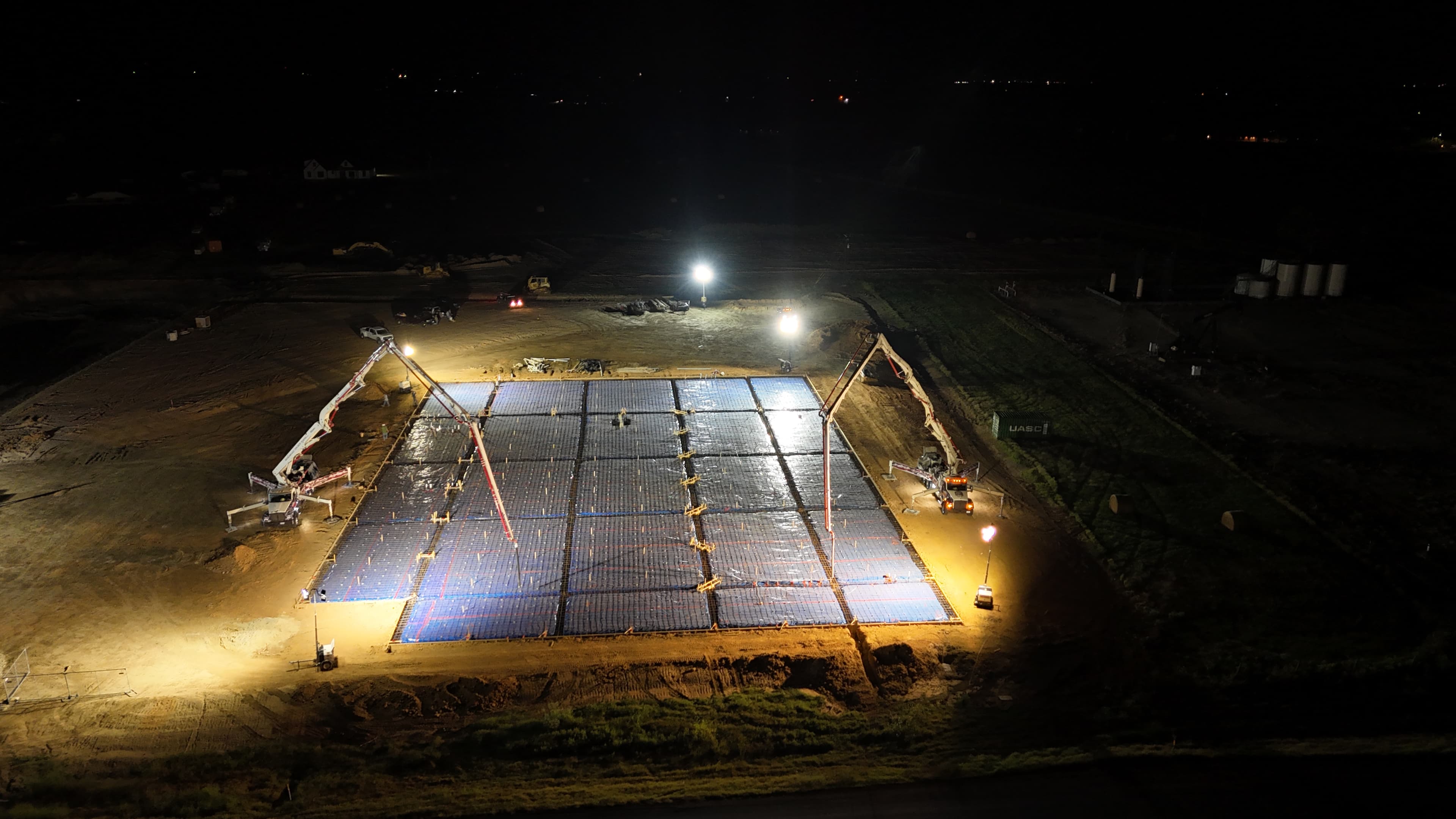
Industrial Concrete in Texas
Heavy-duty industrial concrete construction
Industrial Construction in Texas must meet specific performance requirements including load capacity, chemical resistance, abrasion resistance, and flatness. We work with engineers and facility managers to design appropriate solutions for each application and we execute those designs with the trade knowledge required to hit specifications on the first pour.
Warehouse slab design in Texas begins with the soil profile beneath the slab, not the slab itself. We pull geotech reports before developing concrete section recommendations. Houston black gumbo requires vapor barrier selection, pre-soak protocols to bring soil moisture to near-optimum before concrete placement, and post-tension or fiber reinforcement to manage shrinkage cracking over an inherently unstable substrate. DFW Blackland Prairie slabs face similar challenges with the added concern of differential swell at the building perimeter if site drainage is not directing water away effectively. We integrate drainage design, subgrade preparation, and slab reinforcement as a single coordinated scope rather than treating them as separate contractor responsibilities.
ESFR sprinkler-compatible warehouse slabs require specific attention to joint layout and column line locations. ESFR systems use in-rack sprinkler heads positioned relative to rack column lines, and the slab joint pattern must not conflict with anchor bolt layouts for rack uprights. We coordinate rack layout plans against slab joint design during preconstruction to prevent the common problem of rack anchor bolts landing on or adjacent to saw-cut contraction joints. FF/FL specifications for distribution centers serving automated storage and retrieval systems or AGV equipment require F-numbers in the FF45/FL35 to FF60/FL50 range. Achieving those numbers requires laser-guided screed equipment, skilled finisher teams, experienced supervision, and favorable pour conditions. We do not bid super-flat floors unless we have the equipment and crews to deliver them—over-promising flatness on an industrial floor is a significant liability exposure for both the contractor and the facility owner.
Tilt-wall casting slabs carry the most precise tolerance requirement in industrial construction work. The casting bed must be flat enough—typically FF50 or better over the casting zone—that the panel face will release cleanly from the slab and arrive at vertical within plumb tolerances. We pour casting slabs ahead of panel casting with third-party FF/FL verification, grind high spots if needed, and apply bond breaker uniformly so panels release without surface defects. Chemical resistance requirements for manufacturing and petrochemical facilities drive concrete mix design: higher water-cement ratios increase permeability and reduce acid resistance, so we specify w/c ratios of 0.40 or lower for floors exposed to acidic cleaning agents, battery acid, or process chemicals. Epoxy aggregate toppings, metallic hardeners, and chemical-resistant coatings are available as add-on systems where the base construction needs additional protection.
What's Included
- •Industrial application assessment and requirements analysis
- •Specialized concrete mix design for industrial use
- •Heavy-duty reinforcement systems
- •Proper base preparation and compaction
- •Concrete placement with appropriate techniques
- •Specialized finishing for industrial applications
- •Joint design and installation
- •Optional protective treatments or coatings
- •Quality control and testing
- •Coordination with facility operations
Frequently Asked Questions
What permits are required for industrial construction projects in Texas?
Industrial Construction projects in Texas typically require building permits and may need additional approvals depending on scope. Large projects often require engineering review and compliance with industrial building codes. Contractors in Texas handle permit applications and coordinate with local authorities.
How long do industrial construction projects take in Texas?
Industrial Construction project timelines in Texas vary significantly by scope. Small repairs may complete in days, while large new construction can take weeks or months. Contractors in Texas provide detailed schedules after assessing project requirements and coordinating with facility operations.
What makes industrial construction different from standard concrete in Texas?
Industrial Construction in Texas uses specialized mixes with higher strength, chemical resistance, and durability. Reinforcement and finishing techniques are tailored to specific industrial applications. Contractors in Texas select appropriate materials and methods based on operational requirements.
Can industrial construction floors be repaired without shutting down operations in Texas?
Many industrial construction repairs in Texas can be performed with minimal operational disruption through phased approaches and off-hours work. Contractors coordinate with facility managers to schedule work that minimizes impact. Complete shutdowns may be necessary for extensive projects.
What loads can industrial construction floors support in Texas?
Industrial Construction floor load capacity in Texas depends on design, thickness, reinforcement, and base conditions. Floors are engineered for specific loads including forklifts, heavy machinery, and material storage. Contractors in Texas work with engineers to design appropriate load-bearing systems.
How do contractors address chemical resistance in industrial construction in Texas?
Contractors in Texas address chemical resistance through specialized concrete mixes, protective coatings, and proper joint sealing. Chemical exposure assessment guides material selection. Professionals in Texas recommend appropriate solutions based on specific chemicals and operational conditions.
Common Situations
- •Manufacturing facilities need heavy-duty concrete floors that withstand equipment loads and chemical exposure
- •Warehouse and distribution centers require durable surfaces for material handling and storage operations
- •Industrial facilities need concrete repairs or upgrades to maintain operational efficiency and safety
Example Engagement
Service Type
Industrial Construction
Scope
Heavy-duty industrial floor installation for manufacturing facility
Client Situation
Manufacturing facility owner needs new concrete floor system that will support heavy equipment and resist chemical exposure
Our Approach
Assess operational requirements and loads, design appropriate concrete system with engineers, prepare base, install specialized concrete mix with proper reinforcement, finish for industrial use, coordinate with operations
Expected Outcome
Heavy-duty industrial construction floor ready for operations, designed to meet specific load and chemical resistance requirements
Why Choose Us
Free Estimates
Get a detailed project estimate tailored to your specific needs and site conditions.
Expert Consultation
Our experienced team provides guidance on project requirements, permits, and best practices.
Quality Assurance
We ensure all work meets or exceeds local building codes and industry standards.
Thickness Guide
Related Services
Tilt Wall Construction
Efficient tilt-up concrete wall construction for commercial and industrial buildings with rapid erection and cost-effective solutions
Parking Lot Construction
Commercial parking lot design and construction
Streets and Sidewalks
Municipal and commercial sidewalk and street construction
Retail Store Build Out
Complete retail store construction and fit-out services