
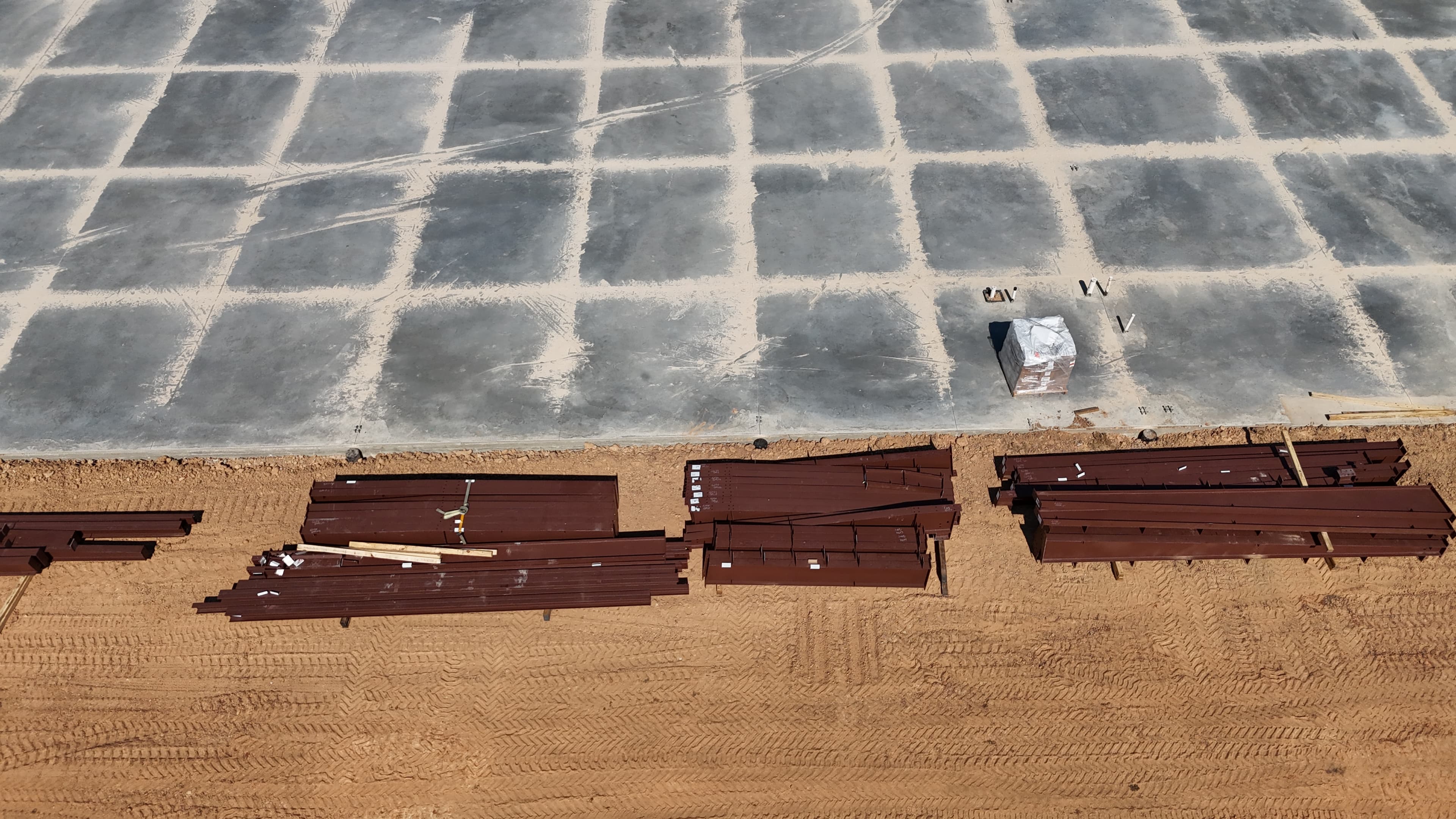
Slab Foundations in Texas
Concrete slab foundation installation and repair
In the Houston metro, commercial slab-on-grade projects on native clay almost always require either a post-tensioned slab designed to flex with soil movement or a drilled-pier-and-grade-beam system that removes the slab from direct soil contact. We have poured both configurations on projects ranging from single-tenant retail pads to multi-building industrial parks. Our crews understand how to manage the timing of post-tensioning stressing relative to concrete strength gain, and we document cylinder break data to confirm the specified strength at stressing.
For distribution centers and warehouse facilities where flatness is a performance specification rather than a cosmetic preference, we target FF45/FL35 or better on the overall floor and FF50+ on defined traffic lanes for narrow-aisle forklift operations. Achieving those tolerances in Texas summer heat requires early-morning pours, laser-guided screed equipment, and experienced finishers who understand the relationship between concrete temperature, water-cement ratio, and surface flatness. We have delivered super-flat floors on projects where the tenant's racking layout and equipment specification drove the flatness requirement, and we have the pour records and F-number reports to document compliance.
ESFR (Early Suppression Fast Response) sprinkler systems are now standard in most Class A warehouse and distribution center construction in Texas, and those systems impose specific slab requirements: the sprinkler pipe hanger inserts must align with the structural slab grid, and the slab must be designed for the water weight and rack loads simultaneously. We coordinate sprinkler layout with the MEP engineer during slab design so that inserts are cast in rather than cored after the fact.
On retail and office projects, our slab work integrates with the site civil design — ensuring that slab finish elevation clears FEMA flood requirements in Harris and Galveston counties, that the vapor barrier system meets IBC requirements for the building occupancy, and that sleeve penetrations for plumbing and electrical are located and sized before the pour. We do not treat the slab pour as an isolated trade; we treat it as the foundation for everything that follows.
What's Included
- •Subgrade preparation including proof-rolling and compaction testing
- •Capillary break layer installation
- •Vapor barrier installation with sealed seams and penetrations
- •Rebar or post-tensioning tendon placement per structural drawings
- •ESFR sprinkler insert coordination and installation
- •Concrete placement with hot weather or cold weather management plans
- •Laser-guided screed for FF/FL flatness specifications
- •F-number testing and reporting for warehouse and distribution center projects
- •FEMA Elevation Certificate coordination on Houston-area flood zone projects
Frequently Asked Questions
What slab thickness is required for commercial buildings in Texas?
Commercial slab thickness in Texas is a function of the imposed loads, the subgrade conditions, and the structural engineer's design rather than a one-size-fits-all code minimum. Light retail on stable, well-compacted subgrade might use a 4-inch slab with #4 rebar at 18 inches on center, while a manufacturing facility with heavy equipment might require a 7- or 8-inch slab with heavier reinforcement and a treated subbase. Distribution centers targeting super-flat floors often use 6- to 8-inch slabs with post-tensioning or fiber reinforcement to control long-term deflection. On expansive clay sites in Houston or DFW, the structural engineer may specify a thickened edge beam or a turned-down edge that acts as a grade beam to resist differential soil movement. We work from the structural drawings on every project and do not pour a commercial slab without a reviewed design.
What is an FF/FL flatness specification and why does it matter for warehouse slabs in Texas?
FF and FL are the ASTM E1155 F-number system for measuring concrete floor flatness and levelness. FF (floor flatness) measures how flat the surface is over short distances — bumps and dips that affect forklift stability. FL (floor levelness) measures how level the surface is over longer distances — how much the floor pitches or crowns. A standard warehouse floor might specify FF35/FL25, while a distribution center with 40-foot tall selective racking and narrow-aisle forklifts might require FF50/FL35 or better on defined traffic lanes. Getting there in Texas summer heat requires concrete placement before 10 a.m. when possible, mix designs with retarders to extend working time, laser-guided vibratory screeds rather than manual rodding, and experienced finishers who can read the surface as it stiffens. We use a Profiler or F-meter after cure to generate the F-number report the tenant typically requires before rack installation begins.
How does vapor barrier installation work under commercial slabs in Texas?
The vapor barrier — technically a vapor retarder — goes directly under the concrete slab to block ground moisture from migrating up through the slab and damaging flooring adhesives, causing efflorescence, or creating conditions for mold growth in occupied spaces. Texas commercial practice for most building occupancies follows ACI 302.1R guidance: a 10-mil polyolefin vapor retarder on top of a capillary break layer of clean crushed stone, lapped 12 inches at seams and sealed at penetrations. For food-grade facilities, pharmaceutical buildings, or any building with a high-performance epoxy or urethane floor coating, we specify a 15-mil reinforced vapor barrier and confirm that the floor coating manufacturer accepts the barrier as vapor protection. In coastal Houston where water tables can be within a few feet of the surface, vapor management is not optional — it is a warranty-preserving specification.
Can a slab foundation be poured during Texas summer heat?
Yes, but hot weather concrete placement requires active management that we build into our pour plans. ACI 305R defines hot weather as conditions where the concrete temperature at placement exceeds 90°F or where temperature, humidity, and wind combine to produce rapid evaporation. In Houston from June through September those conditions are routine. Our mitigation measures include: concrete batch plants that ice the mix water to reduce concrete temperature at delivery, pour scheduling that begins before sunrise and targets placement completion before 10 a.m. on the largest pours, evaporation retarder sprayed on fresh concrete after screeding to buy additional finishing time, curing compound applied immediately after final finish, and wet-curing blankets on slabs where tenants require F-number performance. We will not pour a slab when ambient conditions exceed our mix design parameters, and we document jobsite temperature and humidity at placement in our QC records.
How do FEMA flood elevation requirements affect slab design in the Houston area?
FEMA flood elevation requirements determine the minimum finished floor elevation for new commercial construction in flood zones, and that FFE requirement directly sets the slab elevation. In Harris County, the FFE must exceed the Base Flood Elevation from the FEMA FIRM map plus the local freeboard requirement — which ranges from 6 inches to 2 feet depending on the municipality and the flood zone designation. The practical effect is that the top of the structural slab must be elevated to that FFE, which can require a raised-slab construction with stem walls and fill, or a slab poured on engineered fill that has been certified by a geotechnical engineer to not settle over time. We coordinate the slab elevation with the civil engineer and the floodplain administrator before we design the forming system, and we provide a FEMA Elevation Certificate at project completion documenting the as-built FFE.
What maintenance do commercial slab foundations require in Texas?
A well-built commercial slab on a properly prepared subgrade in Texas requires minimal ongoing maintenance. The primary items to monitor are: surface cracking at control joints — if cracks develop mid-panel rather than at the joints, it suggests that joints were not cut promptly after pour, subgrade was not properly compacted, or the slab is experiencing differential settlement; drainage at the building perimeter — grading should direct surface water away from the slab edge, and any settling that creates ponding adjacent to the slab edge can accelerate soil saturation and slab movement on clay sites; and joint sealant condition — control joints and isolation joints should be resealed with polyurethane sealant when the existing sealant cracks or debonds, which typically occurs every five to ten years depending on traffic. For post-tensioned slabs, the tendon anchor pockets at the slab edge should remain sealed to prevent corrosion of the tendon chuck and anchor plate.
Common Situations
- •A distribution center developer in the Katy/Highway 10 corridor needs a 250,000-square-foot FF50/FL35 super-flat floor on drilled piers and a grade beam system, with post-tensioned interior slab panels
- •A retail developer in suburban Dallas needs a 4-inch post-tensioned slab on Blackland Prairie clay soil, designed to flex with seasonal soil movement without cracking the finished floor
- •A medical office group in San Antonio needs a 5-inch conventionally reinforced slab on caliche subgrade with stem walls elevating the FFE above a Zone AE base flood elevation
Example Engagement
Service Type
Slab Foundations
Scope
A logistics company is constructing a 180,000-square-foot cross-dock distribution center near the Port of Houston. The project requires a 6-inch post-tensioned slab on drilled piers with FF50 flatness on two defined forklift traffic lanes and ESFR sprinkler insert coordination throughout.
Client Situation
The site is on soft Gulf Coast clay with a high water table. The geotechnical engineer has specified drilled piers at 15-foot centers to stable bearing at 30 feet, with the post-tensioned slab isolated from the subgrade by a vapor barrier and granular drainage course. The tenant's narrow-aisle forklift spec requires F-number documentation before rack installation.
Our Approach
We install piers, set grade beams, place the interior capillary break and 15-mil vapor barrier, install post-tensioning tendons, coordinate ESFR insert layout with the sprinkler contractor, pour in early-morning sections using retarded mix to extend finishing time, apply evaporation retarder during finishing, stress tendons at 2,500 psi cylinder break, and measure and report F-numbers across the full floor before tenant access.
Expected Outcome
A super-flat slab meeting FF50 on traffic lanes, properly elevated above the Harris County BFE, with a complete QC package including geotechnical compaction reports, concrete cylinder breaks, tendon stressing records, and F-number survey.
Why Choose Us
Free Estimates
Get a detailed project estimate tailored to your specific needs and site conditions.
Expert Consultation
Our experienced team provides guidance on project requirements, permits, and best practices.
Quality Assurance
We ensure all work meets or exceeds local building codes and industry standards.
Thickness Guide
Related Services
Comprehensive Building Foundations
Professional foundation construction for commercial and residential buildings
Retaining Walls
Structural retaining walls for slope management and property boundaries
Pier and Beam Foundations
Pier and beam foundation construction and maintenance