
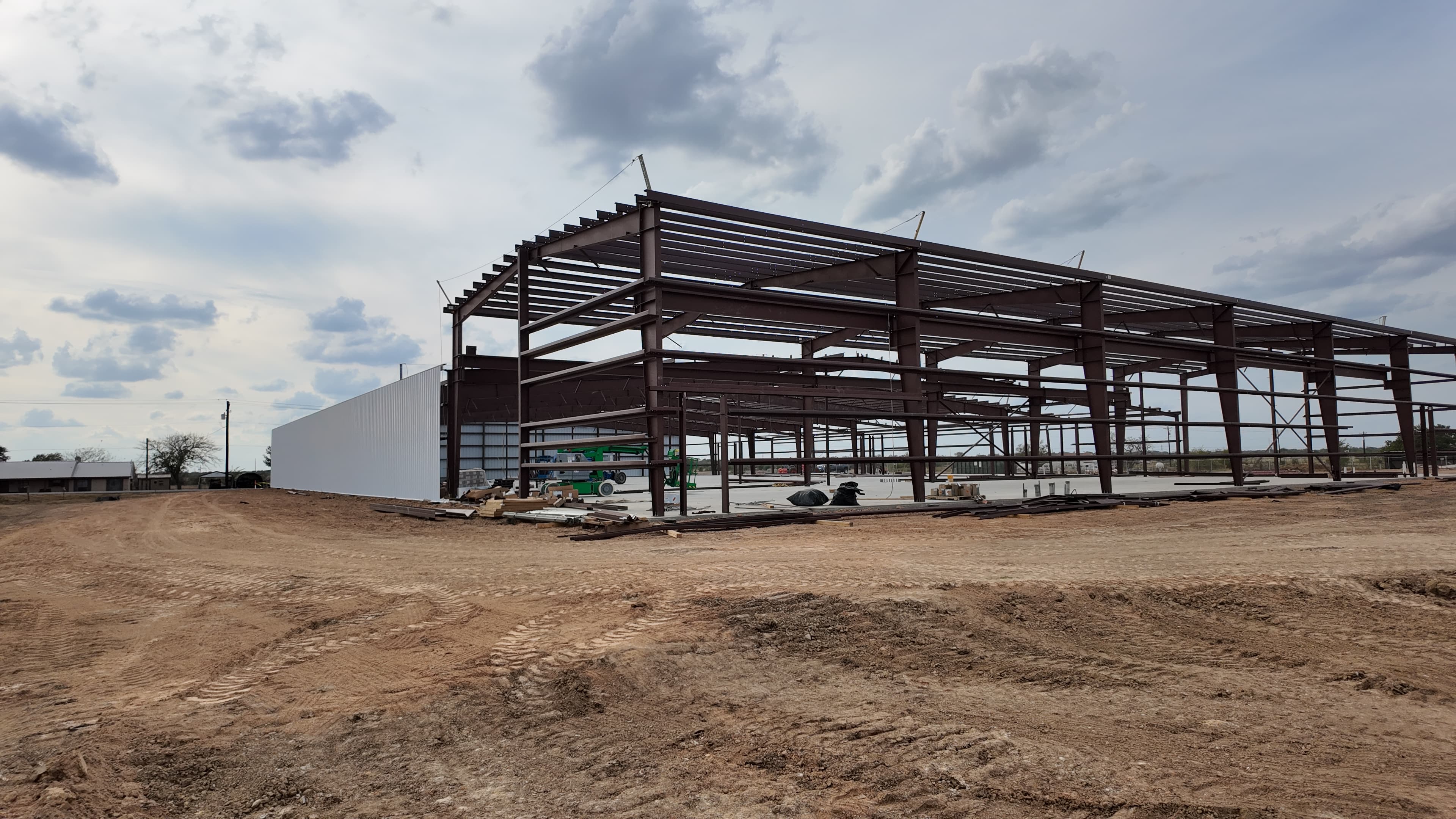
PEMB Pre-Engineered Metal Buildings in Texas
Pre-engineered metal building construction and installation
The distinction matters because the most expensive PEMB problems aren't erection problems, they're coordination problems. Anchor bolt templates that don't match the foundation as-built. Roof penetrations for HVAC curbs that weren't dimensioned in the original building order. Dock door rough openings that don't accommodate the leveler manufacturer's specified framing. We've seen all of them on projects where the PEMB supplier, the foundation contractor, and the equipment vendor were operating independently. Our role is to collapse that coordination into a single point of accountability so those conflicts are caught in the shop drawing phase rather than on the erection schedule.
Texas climate drives significant decisions in PEMB specification. On the Gulf Coast and Beaumont-Port Arthur corridor, coastal atmospheric corrosivity (ASTM C1 to C4 classification depending on proximity to salt water) requires zinc-rich primer systems on structural steel, galvanized secondary framing, and Kynar or siliconized polyester panel coatings rather than standard polyester for exterior panels. Inland North and West Texas see Class 4 hail events that can damage standard 26-gauge panels — insurance carriers in the DFW and Panhandle markets increasingly require 24-gauge or 22-gauge standing seam roofing and impact-rated wall panels as a condition of commercial property insurance. We specify building systems that match the local risk environment, not just the minimum IBC code requirements.
Tornado Alley exposure runs across North Texas through the Red River corridor into Oklahoma. Texas Tech's Wind Science and Engineering Research Center has documented wind events exceeding design pressures in multiple North Texas counties. We ensure our PEMB specifications include proper exposure category (B, C, or D per ASCE 7) for the project location and verify that the manufacturer's stamped drawings match the local wind speed map rather than using a generalized Texas wind zone. The difference between a properly specified and an under-specified PEMB frame is measurable in the number of anchor bolts and girt-to-column connection details — and the difference shows up when 80-mph straightline winds hit the Panhandle in March.
Foundation coordination on PEMB projects is where construction expertise and steel knowledge have to intersect. Column reactions from PEMB frames are typically high-uplift loads that require anchor bolt embedment depths and reinforcing layouts that conventional commercial slab design doesn't address. We work with the structural engineer of record on PEMB reaction summaries provided by the manufacturer to design column footings that resist both vertical compression and the uplift forces generated by wind suction on the roof panels. On large clear-span buildings — 200 feet and wider — internal frame reactions can create significant thrust forces that require grade beams or tie rods between opposing column lines to avoid lateral spread. Missing that element is a structural failure mode, not a cosmetic deficiency.
Interior finish-out in PEMB buildings for industrial use means coordination with mechanical, electrical, and process equipment vendors from the building order date. HVAC curb locations need to be designed into the roof panel layout before the building is fabricated. Overhead crane rails and runway beams need to be incorporated into the structural frame — added after erection as a field modification they're expensive and structurally complex. Insulation selection (single-layer blanket, double-layer, or rigid board systems) affects both thermal performance and roof panel uplift resistance and has to be coordinated with the building manufacturer's panel anchorage system. We manage all of it under a single project management structure.
What's Included
- •Building program development and manufacturer coordination
- •Wind speed, exposure, and occupancy analysis for PEMB specification
- •Structural engineer of record engagement for foundation and PEMB coordination
- •Anchor bolt template design, verification, and as-built survey
- •Foundation design for PEMB column reactions including uplift and thrust
- •PEMB erection by certified crews with crane operations
- •Roof and wall panel installation with proper anchorage to manufacturer specs
- •Insulation system installation coordinated with thermal and fire code requirements
- •Door, window, and louver framing to PEMB opening schedule
- •Coordination of HVAC curbs, crane runway beams, and overhead MEP penetrations
- •Building enclosure and weather-tight inspection before interior trades mobilize
- •Compliance with Texas IBC and local municipality building code requirements
Frequently Asked Questions
What PEMB building sizes and types do you construct across Texas?
We construct PEMB warehouses, distribution centers, manufacturing facilities, flex-industrial buildings, and agricultural structures ranging from 5,000 to 500,000+ square feet across Texas. Clear-span widths up to 300 feet are achievable with standard rigid frame systems. Multi-span buildings can extend to any length. We coordinate with manufacturers including BlueScope, Nucor, Robertson, and regional suppliers to match building specifications to site-specific wind, seismic, and occupancy requirements.
How do you handle Class 4 hail and high wind requirements in North Texas PEMB projects?
North Texas commercial insurance carriers increasingly require Class 4 impact-rated roofing and walls as a condition of commercial property coverage. We specify 24-gauge or 22-gauge standing seam roof panels with Class 4 FM 4473 impact ratings and coordinate with the insurer's risk engineer on panel specification before the building order. Frame design follows ASCE 7 wind speed maps for the specific project county, not generic Texas statewide values — exposure category and local wind speed can meaningfully change anchor bolt and connection design.
What coastal corrosion specifications do you use for Gulf Coast PEMB projects?
On Gulf Coast sites within 1 to 5 miles of salt water (ASTM C3-C4 atmospheric corrosivity zones), we specify hot-dip galvanized secondary framing, zinc-rich primer on structural members, and Kynar 500 or PVDF panel coatings for exterior panels rather than standard polyester. Anchor bolt and base plate assemblies use hot-dip galvanized or 316 stainless hardware. These specifications add cost but eliminate the accelerated corrosion that standard PEMB systems experience in coastal environments within 5-10 years.
How do you coordinate anchor bolt templates between foundation and building erection?
We establish a single set of anchor bolt shop drawings approved by both the structural engineer of record and the PEMB manufacturer before foundation forming begins. The approved template is used by the concrete foreman and verified by our superintendent with a template check before pour. After pour, we survey each anchor bolt cluster and compare to the approved layout — any out-of-tolerance condition is resolved before the building manufacturer's steel is released for fabrication. This process eliminates the field modification expense that occurs when bolts don't match the manufactured frame.
How do you integrate overhead crane systems into PEMB structures?
Overhead crane runway beams and rails must be incorporated into the PEMB structural design from the start — they create point loads and lateral thrust forces that the standard rigid frame isn't designed for without engineering input. We obtain the crane manufacturer's runway beam reaction and wheel load data before the building order is placed and submit that data to the PEMB engineer of record for frame reinforcement. Crane rails and runway beams are erected as part of the building erection sequence, not as an afterthought.
What is a realistic schedule for PEMB design, fabrication, and erection in Texas?
A standard PEMB warehouse in the 30,000 to 100,000 SF range typically runs: 4-6 weeks for design, permitting, and building order; 10-14 weeks for factory fabrication and delivery lead time; 4-8 weeks for foundation and site work concurrent with fabrication; and 3-6 weeks for erection and enclosure. Total schedule from notice to proceed to dried-in building typically runs 20-30 weeks for a standard project. Tight schedules can be accelerated with pre-engineered stock buildings or fast-track permitting, but the fabrication lead time is a fixed constraint regardless of other schedule pressure.
Common Situations
- •A logistics developer in the DFW Metroplex needs a 200,000 SF distribution center on a 20-week schedule with Class 4 hail-rated roofing required by the property insurer before the lease will be activated
- •A Gulf Coast petrochemical operator needs a 40,000 SF maintenance and equipment storage building within 1 mile of salt water requiring C4 coastal corrosion specifications on all exposed steel and panel coatings
- •A West Texas oilfield services company needs a 60,000 SF clear-span equipment maintenance facility with two 10-ton overhead cranes incorporated into the structural frame, on a caliche site requiring hydraulic hammer for utility trenching
Example Engagement
Service Type
PEMB Pre-Engineered Metal Building Construction
Scope
Complete PEMB GC delivery of a 120,000 SF distribution center with 32-foot eave height, 6 drive-in doors, 18 dock-high positions, LED high-bay lighting, ESFR fire protection system, and 5,000 SF office build-out, on an 18-week schedule from permit to tenant occupancy
Client Situation
A national third-party logistics (3PL) company needed to establish a Texas regional hub with a specific occupancy date tied to a customer contract. PEMB was selected for schedule certainty and cost efficiency. The site was in a Class C exposure wind zone requiring full wind load analysis.
Our Approach
We ordered the PEMB building concurrent with permit application and began foundation work immediately upon permit approval, compressing the critical path. Dock door positions and ESFR sprinkler riser locations were coordinated with the building manufacturer during shop drawing review to eliminate field modifications during erection.
Expected Outcome
Building delivered dried-in 17 weeks from NTP, with interior fit-out and tenant occupancy completed within the contractual milestone.
Why Choose Us
Free Estimates
Get a detailed project estimate tailored to your specific needs and site conditions.
Expert Consultation
Our experienced team provides guidance on project requirements, permits, and best practices.
Quality Assurance
We ensure all work meets or exceeds local building codes and industry standards.